
The wave
The best-laid schemes o’ mice an’ men
Gang aft agley,
An’ lea’e us nought but grief an’ pain,
For promis’d joy!
To a mouse, 1785, Robert BurnsBurns’ poem, written when the Scottish author was but 26 years old, predicted, with art’s unique paradoxical way, the author’s adventurous and short life, and simultaneously set forth, once more, what the ancient Greek tragedy, the eastern epics, the northernmost myths and the great works of humanity have always been saying.
Of Mice and Men, 1937, John Steinbeck
In “Of Mice and Men” John Steinbeck reiterated in a rather particular way, how fragile that sole breath that intervenes between birth and death is, and how futile the effort to be accurately designed. Moreover, the first title of the work, before Steinbeck having read Burns’ poem, was “Something that happened”. The 20th century diffused into “low culture”, entertainment, comics, films, music, television and later the YouTube and other networking platforms, the same primary agony for life as an event, with new, often illegible, features. What was mainly sought, and is still painfully and persistently being sought in this century of hyper-hybridization, is the extent to which human, the “incorrigible dreamer” (André Breton), contains the beast within and dreams through it, grasped by reality, unable to understand the nature of power, alone or collectively.
Giorgio Agamben attempted to capture the concept of demonic as our internal “divine impotence”, precisely in our relationship with the Other: “Fleeing from our own impotence, or rather trying to adopt it as a weapon, we construct the malevolent power that oppresses those who show us their weakness.” (“The coming community”, Indiktos, 2007).
Art is trying to capture this most intimate matter, the mass that is stirred internally and flows externally, like the “deep green” Salinas River, with which Steinbeck’s work begins and ends.
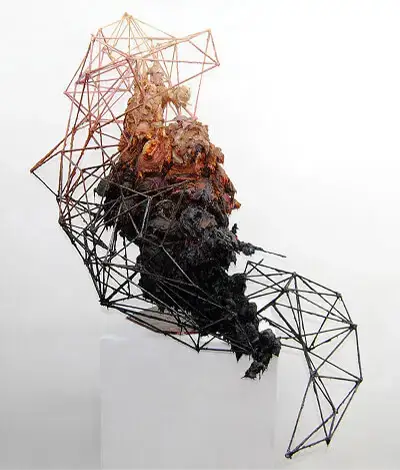
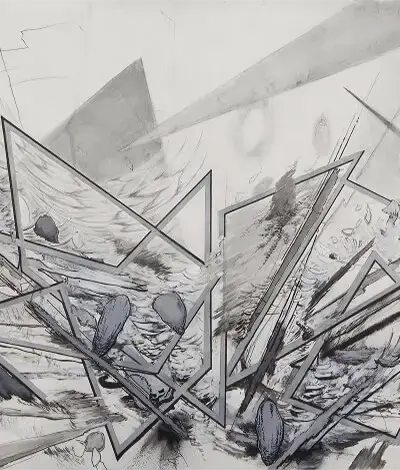
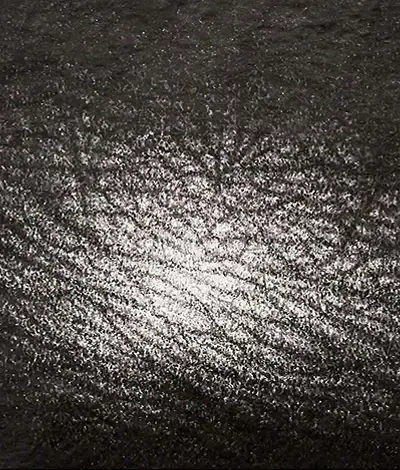
Panos Famelis is creating “The Wave” which is being presented at the current exhibition. He is testing matter in all subsequent attempts to give sculptural substance to the painting gesture and the aura of performance to the three dimensional born object.
His works are always open, between birth and collapse, undecided, unclear, misleading as to the direction of the paste and unstable as to its formation. The almost lunatic accumulation of matter and its shapes, a kind of controlled reversed explosion, is visible even to works that he has created participating in the collective platform Under Construction (furniture, scaffoldings, files), where the structure of power, in its terrible anonymity, as well as the impotence of an average person to reimburse it with a face or body, is studied with constructions, interventions and actions of experiential formula.
What is it that makes “The Wave”, as it is currently appearing, four by three meters and 350 kilos of knots and daunting oil lumps, a key work, a somewhat joint in the body of Famelis’ work?
This work of art, as it is being displayed on its own, following its creator’s wish, seems to condense references, to summarize their ways of management and to stabilize a personal language.
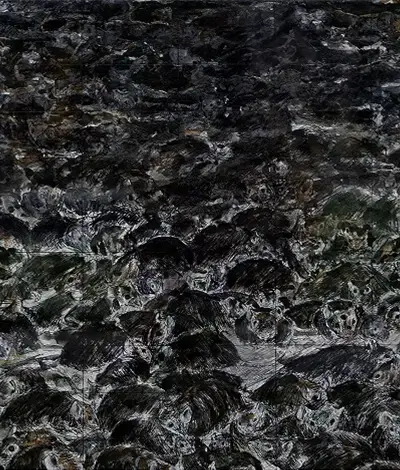
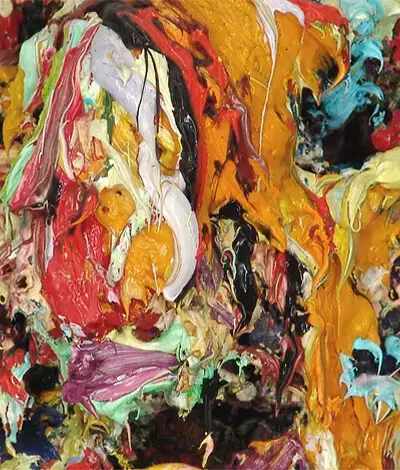
It is a clear, though not definitive, victory in the extremely difficult management of the intractable, marshy paste that is pushing space literally and figuratively, and is counting time and effort in relation to both creator and spectator. The rawness of things, something that in the past has been connected with Bataille’s basesse, the concept of Low and Amorphous in Famelis’ case, acquires monumental dimension in “The Wave”.
It is revealed as a gaping wound, gateway (or swamp) from which the matter of painting is emanated and to which it tends as the matter of life itself, crude and imperfect, potentially foul as a form that is approximating the absence. Like the other side of the same coin, it marks the artist’s interest in the mechanisms of social cohesion and the tools to understand and improve these mechanisms.
As a laboratory study of a universe “that does not look like anything” and “is creeping everywhere like a spider or a worm”, the hidden mouse nest of “The Wave” is one of those images that recall broader reflections on the destiny of humanity: If “there are no longer social classes but just a single planetary petty bourgeoisie in which all the old classes are dissolved … the form in which humanity is moving towards its own destruction”, “the planetary petty bourgeoisie represents an opportunity unheard of in the history of humanity”, to enter that is, every human as a common and perfectly exposed singularity into “a community without presuppositions and without subjects, into a communication without the incommunicable”.
It is the elegiac swarm of the damned that Dante and Virgil first hear and then see, the “legion” of the New Testament, the buzzing of the bees in the 1978 cult thriller, but also an impressive collection of modern technological achievements in simulation in the cinema of the era of “The Lord of the Rings”. It coincides with Aristotle’s, Marx’s, Hobbes’, Bergson’s, Badiou’s, Deleuze & Guattari’s theories, with the musical compositions of chaos in Xenakis:
the swarm, the herd, the multiplicities are the multitude that is governed by unknown, undefined laws of behavior and permeates its environment in a manner that violates the conventional individual-collective relations, bears the promise and threat of change, the influence first and then the responsibility.
Relevant studies, complex and in a wide range of research areas, lead to the conclusion of abstract motifs that are constantly crossing the border of individual-collective, nature-culture. Eventually it may be right that “there’s one notion of multitude that’s always-already and there’s another that’s not yet” (Michael Hardt).
“The Wave” is on such verge, whereas its spectator lies at the precarious nexus of perception and understanding.